

Jun 13, 2026
Booking a local taxi is straightforward. You call, give your postcode, and a car arrives. Booking a taxi for a long distance journey is a different process, and getting it right saves you money, avoids nasty surprises, and means the driver who turns up at 5am actually has the right vehicle for your bags and your group.
This guide walks you through the full process, from choosing the right operator to what to have ready when you call.
In the UK, any journey exceeding 30 miles typically falls into the long distance category. These trips go beyond your local area and often involve intercity travel, airport transfers, or regional journeys that require advance booking rather than a quick street hail.
The key word is advance. Long distance taxi journeys are planned transport, not on-demand rides. You cannot flag one down. You need to book through a licensed private hire operator, confirm the details in writing, and ensure the vehicle that turns up suits your actual needs.
Here is why this matters: a driver turning up in a standard four-seat saloon when you have three large cases and two passengers is a problem that is very easy to avoid at the booking stage, and very annoying to deal with at your front door at 4:30am.
The first decision is which company to book with. Not all operators are the same, and for a long distance journey, the difference between a reliable operator and an unreliable one is felt more sharply.
Here is what to look for:
A valid private hire operator licence. Every company dispatching private hire vehicles in the UK must hold a licence issued by their local council. Licensed drivers are DBS-checked, fully insured, and driving vehicles that have passed a council roadworthiness inspection. This is not optional, and it is not a premium feature. It is the legal baseline.
Fixed, transparent pricing. For long distance journeys, fixed fares are the right choice. You should know exactly what you will pay before booking. No surprises, no meter watching, no hidden charges. A metered fare on a long journey adds real uncertainty: if you hit traffic on the motorway, the fare climbs. A fixed fare agreed at the time of booking does not change.
24/7 availability. Long distance journeys often involve early morning departures or late-night arrivals. A reliable operator does not stop taking bookings at midnight. Before you book, confirm the company operates at the time you need them.
A fleet suited to long journeys. Comfort matters on a two-hour or three-hour drive in a way it does not for a ten-minute hop across town. Ask about the vehicle type available for your journey. A saloon is fine for two passengers with modest luggage. An MPV or people carrier is a better choice for a family of four with full holiday baggage.
Reviews from real customers. Check Google and independent review platforms. Look specifically for comments about punctuality, communication when something changed, and whether the driver arrived in the right vehicle. These are the details that matter on a long trip.
Long distance bookings need more detail than a local run. Have the following ready before you contact the operator:
When booking, have it ready: pickup address, destination, date and time, number of passengers, amount of luggage, and any special requirements like child seats or wheelchair accessibility.
This is one of the most common mistakes passengers make when they book a taxi for a long distance. They receive a verbal quote, confirm the booking, and then feel uncertain about the price when the journey ends.
A reputable operator will confirm the fare in writing, either by email, text, or WhatsApp, as part of the booking confirmation. That confirmation should include:
If the confirmation does not include all of these, call the operator and ask for them. This is not pedantry. On a long journey, clear written confirmation protects both you and the driver if there is any confusion on the day.
For 2025, all private hire bookings in the UK must be made through licensed operators, and those operators are required to keep accurate records of every booking. That obligation creates a paper trail that protects passengers. A booking without written confirmation has no paper trail.
Getting this right at the booking stage prevents the frustrating scenario of a vehicle that does not fit everyone or everything you are taking.
Here is a practical guide:
Standard saloon (up to 4 passengers, 2-3 medium bags) Good for a couple or small group travelling light. Cost-effective on long runs.
Executive saloon The same passenger capacity as a standard saloon, but a more comfortable and quieter ride. Suited to business travel or anyone spending two or more hours in the car.
MPV or people carrier (up to 6 passengers, larger luggage capacity) Right for a family with full holiday bags, or a group of four or five travelling together.
Minibus (6, 8, or 16 passengers) For group travel, a minibus keeps everyone together and significantly reduces the per-person cost. For groups of four or more, sharing a minibus is often cheaper per head than separate smaller cars, and frequently cheaper per person than train tickets.
Long distance taxis can be more cost-effective for groups, families, or business travel, especially with door-to-door service, no transfers, and more luggage space. For groups of three or more, taxis often work out cheaper per person when you split the fare.
For local journeys, the pickup time is simple: you want the car in ten minutes. For a long distance run, the timing calculation is more involved.
Work backwards from your arrival deadline. If your flight checks in at 07:00 and closes at 07:30, and the airport is an hour away with normal traffic, you need to be at the terminal by at least 06:45. Add a buffer for check-in queues and security. A 05:15 departure from your address gives you a reasonable margin. A 06:00 departure does not.
Tell the operator the time you need to arrive at the destination, not just the pickup time you have in mind. A good operator will check the timing makes sense and flag it if it does not.
Be ready on time. Drivers plan routes based on your scheduled pickup. Being ready ensures you depart on schedule and reach your destination as planned.
Fixed fares are standard for pre-booked long distance private hire in the UK. But it helps to understand what goes into the price so you can compare quotes fairly.
Distance is the primary driver. The farther the journey, the higher the cost. A 100-mile taxi journey typically costs between £200 and £350, depending on the vehicle type, provider, and time of travel.
Vehicle type affects the price. An executive car or minibus costs more than a standard saloon. Book what you actually need, not the cheapest option that will not comfortably fit your group and luggage.
Time of travel can affect pricing. Night-time surcharges, typically applied after 10pm or midnight, reflect reduced driver availability. If your timing is flexible, ask whether travelling at a different time changes the quote.
Stops and waiting time. A clean point-to-point journey is the simplest to price. If you need a stop of more than a few minutes, discuss this at booking. Some operators include brief comfort breaks on long journeys at no extra charge; others apply a waiting time fee.
Return journeys. Booking both legs together often works out better value than two separate quotes.
The train is often the right choice for a solo traveller on a well-served direct route who has booked an advance ticket. But the calculation changes in several common situations.
Travelling with luggage. Dragging large cases from a station car park, onto a platform, into the luggage rack, off again at a connection, and onto a bus or another taxi at the other end is genuinely unpleasant. A taxi loads at your door and unloads at your destination.
Travelling as a group or family. For groups of three or more, the per-person cost of a taxi with a fixed fare often matches or beats multiple train tickets, without the complexity of connections, platform changes, or restricted luggage.
Early morning or late-night journeys. Trains do not run at all hours. A licensed private hire operator running 24 hours does.
Destinations poorly served by rail. Many towns in Lancashire and the surrounding area are not on direct rail routes to major airports or other cities. A long distance taxi connects your front door to any destination without requiring you to drive to a station, pay for parking, and manage connections.
Once the booking is confirmed, a few straightforward steps make the journey smoother.
Save the driver's contact number. This is included in any proper booking confirmation. If you are running a few minutes late, or if your flight lands early on a return, call the operator directly rather than waiting and hoping.
Check the booking confirmation carefully. Confirm the date, addresses, and time are all correct. Mistakes happen at the point of entry, and catching them before the journey is much easier than explaining on the day.
Communicate changes quickly. If your plans change, contact the operator as soon as you know. Most operators can accommodate reasonable changes, but late notice on a long distance booking leaves drivers committed to a journey they are already planning for.
For passengers in Penwortham, Bamber Bridge, Leyland, Lostock Hall, Chorley, and the wider South Ribble area, long distance journeys most often involve airport transfers to Manchester, Liverpool, Leeds Bradford, or the London airports, as well as intercity runs and hospital or specialist appointment travel.
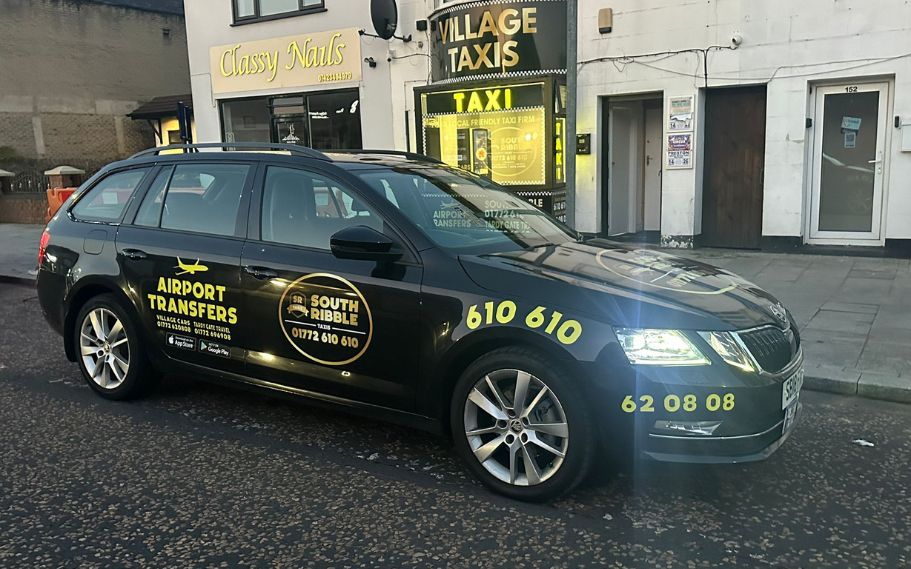
South Ribble Taxis offers fixed-fare long distance taxi bookings across all of these routes, with vehicles from standard saloons through to 6, 8, and 16-seat minibuses for group travel. All drivers are licensed and vehicles are council-inspected. Bookings can be made by phone, WhatsApp, or online, with written confirmation sent for every long distance run.
1. How far in advance should I book a long distance taxi?
Book as early as you can, particularly for early morning departures, airport runs, or group travel requiring a minibus. Booking in advance guarantees availability, locks in the fixed fare, and gives the operator time to assign the right vehicle. A few days' notice is usually sufficient for most journeys, but peak holiday periods and weekends fill up faster.
2. Will the price change if there is traffic on the day?
Not if you have booked a fixed fare through a licensed private hire operator. The price agreed at the time of booking is the price you pay, regardless of traffic conditions. This is one of the main reasons fixed-fare booking is the right choice for long distance journeys over a metered arrangement.
3. Can I make stops during a long distance taxi journey?
Most operators accommodate reasonable stops when arranged in advance. Brief comfort breaks are often included on journeys of two hours or more, but extended stops or significant detours may incur additional charges. Agree on any planned stops at the time of booking, not on the day.
4. Is a long distance taxi cheaper than the train for a family?
For groups of three or more, a long distance taxi often works out cheaper per person than separate train tickets, especially at short notice when advance train fares are no longer available. The comparison also changes when you account for the cost of getting to and from the station, parking, luggage restrictions, and connection time.
5. What details do I need to book a long distance taxi?
You need: the full pickup and destination addresses including postcodes, the date and time of travel, the number of passengers, the amount and size of luggage, any required stops, any special requirements such as child seats, and whether you need a return journey. Having all of this ready before you call or book online means the operator can give you an accurate fixed quote immediately.


.svg)

Officially Gold Standard Awarded taxi operator! Book with confidence.
© 2026 South Ribble Taxis. All Rights Reserved.


